Saturday, 19 August 2017

Bad Boys 2


2003’s “Bad Boys 2”, directed by Michael Bay.

Starring Will Smith, Martin Lawrence, Jordi Molla, Gabrielle Union, Theresa Randle, Peter Stormare, and Michael Shannon.
Back for more, we again meet flamboyant (and borderline paramilitary) Miami drug cop partners, Martin Lawrence and Will Smith. Lawrence continues to be a family man, while Smith is a lone wolf always ready to impress the ladies. After going undercover at a klu klux clan rally, the 2 of them stumble into a plot where a Columbian drug lord is using dead bodies and coffins to smuggle narcotics and cash across borders. While trying to infiltrate the cartel’s operation, they run into an undercover federal agent (Union), whom the gang needs to help protect her identity, while Smith tries not to spill the beans about how he’s dating her- as she’s also Lawrence’s sister. While this goes on, their perpetually frustrated captain (Joe Pantoliano) tries not to have a stroke to at the duo’s antics, and the drug lords make things personal when their backs are against the wall- forcing the bad boys to dig deep.
“Captain, these are not normal corpses.” With these words we are forced to evaluate why we decided to watch Michael Bay’s follow up to his 1995 black buddy cop film, “Bad Boys”. “BB2” is a hyperextension of the first film- more vague cop scenarios, more car chases, more shoot outs, more banter. Unfortunately for the sake of tolerance, there’s also plenty of racism, misogyny, sexism, class warfare, nudity, homophobia, increased screen time, and just bad taste. At a psychologically numbing 2 hours and 27 minutes, you get more than enough opportunity for Michael Bay to showcase his strengths and subsequent weaknesses: flashy, gorgeous kinetic images that when put together into a movie, resemble multiple ADHD music videos stitched together. Several of the car chases have the potential to be amazing, to be some of the most dynamic and explosive scenes this side of “Bullit” or “The French Connection”. Unfortunately, Bay cuts everything together until it resembles a shiny junk yard, where it’s impossible to decipher whom is doing what. This is common with Bay- and the characters cycle in and out, saying things and doing things, before the camera starts swirling again. And that’s to say nothing of the stock character Haitian gang villains, who exist to be run over and shot by our heroes here.
What’s worse though, is the 2 protagonists. Lawrence and Smith return for more buddy cop movie cliches, such as their arguing antics and screaming superior (played by Joe Pantoliano, as always in hairpiece). I won’t lie- I’m fascinated by how reprehensibly bad “BB2” is. A cabal of white dudes most certainly thought this piece of shiny rap cop crap would make teenage boys salivate all the way to the multiplex. Lawrence’s character cycles back and forth, between a tough cop out to get results and a dedicated family man, to comedic punching bag and spiritual flake. For reasons unclear, he  vacillates between the 2 arbitrarily, and that’s before he accidentally ingests MDMA. Unbalancing things out, is Smith’s character, whom exhibits zero depth, operating as a 100% in control materialistic narcissist, typically pissed off at people for not giving him the chance to be on top of things, regardless of what bodies he has to run over or feelings he needs to hurt. Condescending but never self aware, he always gets his man, gets the girl, and yells about his misfortune and general circumstances while screaming around town in a Testarossa or Hummer.
Together, the 2 of them jaunt around Miami (and perhaps other countries where they bizarrely do not hold jurisdiction), abusing their power, and existing to meet their own selfish needs. The pair’s coup de gracie is ultimately when a young man comes by Lawrence’s household to take his daughter on a date, and the 2 cops couldn’t be any less funny, while displaying levels of immaturity and just inappropriate hate that would make a neo nazi group squirm. That the ridiculous ugliness slimes in between an already unrealistic wanna-be “Miami Vice” inspired world makes it all the more jarring, a fascinating market tested train crash. With all the bad vibes, “BB2” can use the term, “spoiler alert”, and maybe for the first time be referring to how it’s contents are rotten. As Lawrence confidently projects, “It’s not gay shit- this is man shit.”


1/5


Tuesday, 15 August 2017

Near Dark


1987’s “Near Dark”, directed by Kathryn Bigelow.

Starring Adrian Pasdar, Jenny Wright, Lance Henriksen, Bill Paxton, Jenette Goldstein, Tim Thomerson, Joshua John Miller, Marcie Leeds, and Troy Evans.
Adrian Pasdar leads as a small town farmer’s son, who has little ambition but to sew his wild seeds. One late night, he meets Jenny Wright, who seems a little aloof, and he has trouble acknowledging her rejections to his advances. Stubborn to a fault, before he knows it, she has drank his blood. He isn’t sure what to think about the young lady (other than that she’s a biter), and the next day he sizzles when exposed to sunlight and has little taste for any kind of nourishment but blood. Re-connecting with Wright, she hooks him up with her surrogate vampire family. Lead by the father figure (a sinister Lance Henrikson), with alpha male right hand (Bill Paxton, majestically preening about), with the mother figure (Jenette Goldstein, a chameleon), and the baby of the family (the strangely enigmatic Joshua John Miller). All of them are mistrustful of the new vampire boy that Wright brings home, as Pasdar is still squeamish about murdering people. The rest of the gang show no such reservations, and rampage throughout the American West in the dark hours. While Pasdar struggles with whatever or not he belongs with the undead and with feelings of estrangement from his former blood family, him and Wright work to sort out if they can be in a relationship despite her family’s objections. 
A cult classic, almost to the point where it’s overrated for being underrated, “Dark” is commendable in it’s commitment to a genre that seems commonplace today, but must have felt like it came out of nowhere in ’87. A lean vampire Western, taking place across the badlands of America instead of New Orleans or Europe, certainly had no comparable rivals at the time. Featuring plenty of interesting characters, the most interesting one might be the dream fueled Tangerine Dream score. It features so prominently and expertly (reminding me of “Aguirre: Wrath of God”’s score), that you start to miss it when it is quiet. But as mentioned above, there are plenty of interesting characters, chomping on the flesh of those unlucky enough to be in their wanton path. Bigelow aims high, and creates an original take on a campy idea. The result can be as visceral and impactful as beams of sunlight.


4/5


Monday, 7 August 2017

Barb Wire


1996’s “Barb Wire”, directed by David Hogan.
Starring Pamela Anderson, Udo Kier, Temuera Morrison, Victoria Rowell, Steve Railsback, and Clint Howard.
Set in 2017 America (Oh my gosh, this year!), we learn through the Star Wars-esque crawl that the nation is embroiled in the second civil war, with a fascist government (called the Congressional Directorate and lead by Steve Railsback) poisoning it’s citizens in it’s pursuit for more power, and using martial law. Because it’s the future, retina scanning is the prevalent way to identify residents (and refugees), so contact lenses, to elude the authorities, are all the rage. Employed properly (presumably with the right amount of saline solution), they can be used to escape to the paradise of Canada. Anderson stars as the owner of a bar, who doesn’t want to stick her breasts neck out for no one. Dressing as an S and M escort, she runs the bar and tries her best to not get involved in the politics of the day, while picking up side jobs performing espionage like acts. The resistance (Temuera Morrison and Victoria Rowell) appeals to Anderson to help them instead of just taking the money and running (in slow motion). Will she spend less time having (strategically placed) bubble baths to do the right thing?
For all of those who thought Casablanca wasn’t burlesque enough, Barb Wire is a godsend. Unlike the flat chested and unable to be a chameleon hack, Humphrey Bogart, Anderson here is a master of disguise. First, she imitates a stripper, wowing the crowd with a upside down water show before taking her target. Later, she makes a convincing prostitute, while proving that she can talk low and breathlessly with the best of them, a pouting patina of silicone and leather. Barb Wire is so weird in it’s juvenile adolescent boy masturbatory fantasy that it’s only viable currency is Canadian money. The very embodiment of female oppression, we see a corseted and barely clothed female population here strut around piggish businessmen and human practice targets, who bristle when being called, “babe”. As a film, this is deplorable, convoluted and hacky stuff that showcases just how limited Anderson is, and often feels like a glorified Playboy television commercial (including the painful transitions between scenes). However, as a precautionary tale of a possible future (2017) that is occurring as I write this, it sometimes rings true. We watch our neighbours to the south, with a celebrity distraction obfuscating over an increasingly dysfunctional republic that claims to be a free country, and the xenophobia and tribalism continues to escalate and rot the core of a nation. “Wire”’s ridiculous but dystopian future is only the tip of that lousy iceberg. Unlike barbed wire tattoos, democracy and healthy resistance never gets old.


2.5/5


Indiana Jones and The Kingdom Of The Crystal Skull


2008’s “Indiana Jones and The Crystal Skull”, directed by Steven Spielberg.
Starring Harrison Ford, Cate Blanchett, Shia LaBeouf, Karen Allen, Ray Winstone, John Hurt, Jim Broadbent, and Igor Jijikine.

Set in 1957, we see Ford, this time pitted against Russians (lead by Cate Blanchett, with right hand man, Igor Jijikine). While in New Mexico, Ford and his partner (Ray Winstone) are overtaken by the Reds, looking for alien artifacts that will lead them to El Dorado, the fabled city of gold. Winstone then betrays Ford, and he escapes with his life, while the Russkies get the valuables. Ford goes back to school for his teachings, but finds his job in jeopardy because of the government’s views on him helping the Russkies to find the artifact and get away. Jobless, Ford plans on travelling, when he runs into Shia LaBeouf, who is looking for a mentor (John Hurt) who was lost while looking for skull which could lead to the great city. After a greaser/preppie melee and KGB chase, Ford and LaBeouf take off to Peru to find clues and the Crystal Skull, and it’s not long before they reunite with old flames and old enemies.

It’s interesting that George Lucas and company, with the ability to go to pretty much any point in time (remember in the last film, “Last Crusade”, that Indiana ((and his father)) drank from the fountain of youth), decide to revisit the muscle cars period of Lucas’ Hollywood coming out party, 1973’s “American Graffiti” (set in the 60’s). But Lucas’ inability to see the present (or at least into the 1970’s onwards, which explains why his prequel Star Wars vehicles sound like old Chevrolets), the favouritism offers an interesting take on the Cold War years. Indiana Jones no longer just faces off against greedy competitors and fascist right wing groups, but now also governments, including his own. Coupled with that paranoia, is the legitimate fear of nuclear fire introduced during that time. While “Skull” is not the place to resolve or deal with those themes, it’s an interesting new take for the adventure franchise that previously gave very little thought to the cultural backdrop in which it aired.

As for the movie itself, it’s interesting to see how much things have changed for a zeitgeist that slavishly followed the formidable 80’s franchise. Even if not successful, many have tried to follow the template of swashbuckling fun (Tomb Raider, The Mummy, National Treasure, etc), and however effective, filled a hole in which the Indiana Jones continuing series could have filled instead. Because of this, “Skull” suffers most from the idea that we’ve been here before, feeling disposable at times. This lightness shadows what could have been a commendable performance by the typically reliable Blanchett, but she is hidden behind CGI chases and shouting at underlings. Contradicting his exploits from “Crusades”, Ford does look a lot older here (as he should, 27 years after his first Jones film), but to the film’s credit, it acknowledges his succumbing to his reduced physical abilities. And the film tries to give a subject for the passing of the torch in LaBeouf, who doesn’t have Ford’s heyday charisma (besides Eddie Murphy, who did?). Otherwise, “Skull” is entertaining and moves nimbly, notwithstanding a painful vehicular jungle chase. Could this be it for our fedora clad adventurer? There’s talk of a sequel for 2020, so hopefully the bullwhip can support a walker.


3/5


Trailer: Click Here.

Indiana Jones and The Last Crusade


1989’s “Indiana Jones and The Last Crusade”, directed by Steven Spielberg.
Starring Harrison Ford,  Sean Connery, Julian Glover, Michael Byrne, Denholm Elliot, Alison Doody, John Rhys-Davies, and River Phoenix.

Winner of an Academy Award in Best Sound Effects Editing (Ben Burtt and Richard Hymns).
Nominated for an Academy Award in Best Score (John Williams) and Best Sound (Ben Burtt, Gary Summers, Shawn Murphy, and Tony Dawe).
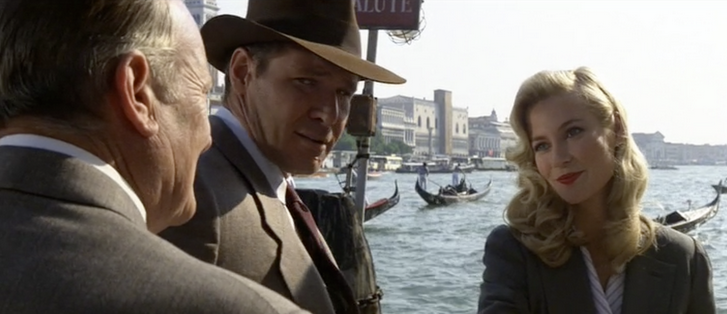
Continuing the theme of glorified B pictures based off of the Sunday Matinee films of their youths, Lucas and Spielberg start the 3rd chapter in the Indiana Jones saga going back to it’s roots. We start in flashback, as we see a young Indiana (River Phoenix), a member of the boy scouts, stealing treasure from an archaeologist (who Jones ends up dressing exactly like in his later years). After a chase that reveals both why Indiana is scared of snakes, and favours a bull whip as an accessory, we quickly move forwards to present day, where Ford is back to his tricks, insisting to a rival that the treasure they’re fighting over belongs in a museum… After shenanigans ensue, including possibly the first double punch in cinema history, Ford ends up back in University, teaching to more awed students. Ford is again approached by a wealthy benefactor (Julian Glover), explaining to Ford that his father (Sean Connery) is missing, along with his diary, detailing Connery's work to find the Cup of Christ, with which to drink from the fountain of youth and possess never ending life. Glover sends Ford, and friend/fool, Marcus (Denholm Elliot), to Venice, where they connect with an intoxicating guide (Doody). While discovering all sorts of ancient clues, Ford has to contend with both, “The Brotherhood of the Cruciform Sword” and the Nazis, one group sworn to protect the grail, and the other desperate for it to have eternal life. Indeed, treachery is everywhere. One way or another, “Crusade” leaves no cartridges left in it’s chambers, as Ford and Connery come together to seek adventure and treasure together.

Perhaps because it was his third shot at it, or a reaction to the grimness (and subsequent reception) of “Doom” (or any combination of those and other unknown factors), Spielberg does right and “Crusade” is easily the closest in tone to the spirit and adventurousness of the Indiana Jones character. Returning to his beloved punching bag villains, the Nazis, Spielberg has the horrific violence (mostly) turned down, but the jokes turned way up. For this reason, Crusade is a rollicking good time, but more importantly, it’s tone is consistent throughout, a problem noted with “Raiders”. Simultaneously, with the flashback to his youth, combined with the introduction of Indiana’s father (a stubbornly set in his ways Connery), we learn more about Jones’ character and motivations than we did in the previous 2 films combined. Hardly a Star Wars or Hobbit prequel of throat clearing introductory nonsense that no human being could ever care about, we find ourselves getting a good idea of why Ford becomes the adventurer he does, and what drives him the most nuts, before he’s off on an insane boat chase or heart stopping tank jaunt. “Crusade” may be overrated merely for the fact that it’s the best Indiana film (bringing into light my feelings on the franchise losing it’s alleged charms over the decades past), and it’s certainly not perfect. For example, it’s clear at this point, that Jones just has terrible taste in women. Being attracted to them instantly, and diving in without so much as a first date before giving them the keys to his life, begs if he even remembers his past relationships that were dysfunctional. Given his slavish female following back home, are we sure the Doody character’s introduction is necessary, even given the background necessary for her actions? And Jones as always will be aimed at the 14 year old in all of us, leading to ridiculous scenarios that Ford typically escapes from (although he IS a doctor). But that’s the aim of the series after all. I can live with it’s (nostalgic) popularity- just as long as we never have to hear Ford attempt an (Irish? Scottish?) accent again.
As the credits roll, we feel both cathartic in what we’ve seen, and excited for the further adventures of the group (tepidly squashed 19 years later in “Kingdom Of The Crystal Skull”).


4/5


Sunday, 6 August 2017

Indiana Jones and The Temple of Doom


1984’s “Indiana Jones and The Temple of Doom”, directed by Steven Spielberg.
Starring Harrison Ford, Kate Capshaw, Jonathan Ke Quan, Amrish Puri, Roshan Seth, Roy Chiao, David Yip, Ric Young, and Raj Singh.

Winner of an Academy Award in Best Visual Effects (Dennis Muren, Michael J. McAlister, Lorne Peterson, and George Gibbs). 

Nominated for an Academy Award in Best Score (John Williams).
Spurred by the success of the original “Raiders”, Spielberg and Lucas reunited to create “Doom”, which (for reasons unclear to me) is actually a prequel to “Raiders” rather than a sequel. We open to a nightclub in Shanghai (called Club Obi-Wan…), where a song and dance number introduces us to the film’s female lead (Kate Capshaw). Ford is involved in a deal with the owners of the nightclub (Roy Chiao, David Yip, and Ric Young, guffawing like frat boys here), where he wants to trade for precious artifacts, but ends up escaping with nothing but his life after getting poisoned. Ford has adopted an orphan (Jonathan Ke Quan, as irritating as ever), who helps with the gang’s escape, and Capshaw ends up coming along on the journey (to ensure there is a romantic lead in the movie). Chiao’s treachery runs deep, and the plane the trio escapes on ends up on a crash course into India. Aided by a trusty lifeboat, the group skydives downwards, before tobogganing through a mountain and river. It is there the trio end up in a village, where the children have all been abducted by a local cult, and the village’s sacred stones have also been stolen. Our trio infiltrates the cult, nestled inside a mountain underneath a palace, and discovers a world of sacrificial rituals and child slavery, with plenty of voodoo practices, endorsed by the child prince of the palace. Ford needs to protect his on the fly family, while working to return the children and stones to their rightful owners in the village.
While “Doom” is a prequel to “Raiders”, it is a much more grim work and feels like the unhappy extension to “Raiders”. Lucas, who had a significant amount of success with his middle Star Wars saga, “The Empire Strikes Back”, pushed against a reluctant Spielberg to make the saga more dark- mission accomplished. Without the Nazis to playfully kick off of cliffs and gleefully push into propeller blades, a sense of grim misery permeates the violent, “Doom”. In addition, Spielberg made the decision to cast his ex-wife as the central love interest, and him and Lucas’ love blues at the time seem to have brought out the more negative feelings to work through, while showing scenes of people having their hearts ripped out of their chests before being lowered while screaming into a pit of fire. On top of the horrific images (which lead to the creation of a PG-13 rating), the character of Capshaw is a significant problem. Shrill and hysterical, it’s not clear why she is brought along with the group after Shanghai, nor why she stays on the journey, nor why Ford is attracted to her. She does make it clear that she is a gold digger, but watching her and Ford go through their battle of the sexes would have been much more welcome with “Raiders” Allen, whom Ford actually shares a lick of chemistry with (and also could have explained the genesis of their relationship in the first place). It’s a downer, and not just because of the negative vibes and accusations of racism towards India and Hinduism (“Doom” was prohibited from being shown in India at it’s time of release), but also because in some ways, “Doom” is a more complete film than “Raiders”, and it’s tone, however grim, is consistent throughout the film. It has it’s share of thrills too, with a kinetic cable car chase and a bridge sequence that could cause a fear of heights for some. And by the ending, we have reasons to cheer, unlike “Raiders”. It’s a shame that Lucas and company couldn’t have taught us more about Indiana Jones, given that we’ve watched him now in 2 feature films, and the sequel is actually a prequel- but I guess anything goes.


3/5

Saturday, 5 August 2017

Indiana Jones and Raiders of the Lost Ark


1981’s “Indiana Jones and Raiders of the Lost Ark”, directed by Steven Spielberg.
Starring Harrison Ford, Karen Allen, Paul Freeman, Denholm Elliot, John Rhys-Davies, Wolf Kalher, Alfred Molina, and Pat Roach.

Winner of an Academy Award in Best Art Direction-Set Decoration (Norman Reynolds, Leslie Dilley, and Michael Ford), Best Sound (Bill Varney, Steve Maslow, Gregg Landaker, and Roy Charman), Best Film Editing (Michael Kahn), and Best Visual Effects (Richard Edlund, Kit West, Bruce Nicholson, and Joe Johnston).

Nominated for an Academy Award in Best Picture, Best Director (Steven Spielberg), Best Cinematography (Douglas Slocombe), and Best Score (John Williams). 
The Indiana Jones series was based around producer/writer George Lucas and director Steven Spielberg’s childhood experiences of watching weekend matinee serials in the 1930’s and 40’s. Heavy on fun and goofy effects, the series regulars could heroically save the day upon viewing, and return for more the following weekend, for what could be called “B pictures”. Seeking to emulate the spirit and tone of the pictures, while ramping up the commercialization, a minor coup was pulled off in casting former failed actor turned carpenter, Harrison Ford, as the film’s leading man (Tom Selleck was originally offered the role). Ford’s (Dr.) Indiana Jones here is an almost mythic hero, an archaeologist who is as comfortable teaching about archaeology to his class of adoring female students, as he is jumping around on moving trucks while punching Nazis. Spielberg’s efficiency (having a background in TV) served him well, as he plows straight ahead, winking at the audience along the way in this glorified B picture series.
We’re introduced, very gradually, to Ford. Clad in his semi iconic uniform of a fedora, leather jacket, and a bullwhip- which comes in handy more often than you would think- the opening sequence of Raiders is a mini movie that sets up the smooth hero’s wild journey (but often desperate humility). Ford is upstaged by a rival archaeologist (Freeman), who has figured out how to seduce the aboriginals into obeying him. This will not be the first time they meet. Loser of a precious artifact to Freeman, Ford returns home, and is approached by a wealthy benefactor friend (Denholm Elliot) and some American officials about recovering an Ark of the Covenant, that could give some serious power to it’s finder. Being set in the 1930’s, the Third Reich also has a significant amount of interest in the ark as well. Ford beelines for Nepal, to recruit an old feisty flame (Karen Allen) to his cause. The ex-couple’s reunion doesn’t go well, but things get too hot to handle when the Nazis show up (lead by a wonderfully creepy Ronald Lacey), in search of a medallion that will help them find the ark. Ford and Allen head to Egypt, where a friend (John Rhys-Davies) helps them in racing the Nazis to uncover the ark first. Unfortunately, again Freeman is neck and neck with Ford, and Ford will have to deal with his life long fear of snakes, dig, climb, jump, drop, swing, and fight his way to the ark before the Nazis can utilize it’s ancient powers.
The Indiana Jones series seems to suffer from the same sort of nostalgia vs. quality issues that Star Wars does (hardly surprising, since Lucas is so involved in both- you can tell because of the Wilhelm scream foleys). While they’re hardly objectively bad films, the gap between how good the series is, and the retroactive affection for them, seems somewhat large. Here, in “Raiders”, we are introduced to Ford’s Jones, and the fantasy world where archaeology is celebrated like movie stars and celebrities today, and a polarized setting where American treasure hunters want priceless artifacts simply for display in a museum, versus greedy rogues from abroad, as well as the universally reviled Nazis seeking them for their power. On the plus side, Ford can’t be faulted for capably embodying the (somewhat) iconic figure of Jones, John Williams yet again creates a legendary theme score (he’s unbelievable), and Spielberg keeps the action racing continuously throughout (“Raiders”, “Jaws” and “Star Wars IV” could be faulted for creating the breathlessly relentless blockbuster summer complex that we have today).

However, for a fun adventure movie that’s aimed at 14 year old boys (or at least the spirit of such), there is a surprising amount of horrific violence throughout the film, alongside punches that ring so loud it’s surprising the victim’s head doesn’t separate clean from their spinal cord. Violence is part and parcel of why I watch movies (it creates conflict and potential resolution- and it really beats the real thing), but it’s presence and how it is depicted is what establishes a movie’s tone. In particular, when the climax plays out, serving as a horrific take on Pandora’s Box, it’s tough to hum along a few minutes later with the adventurous score over the closing credits. Yay? I also agree whole heartedly with Michael Philips of the Chicago Tribune, who claims Indiana Jones isn’t that interesting of a character- at least not until the third entry… Who is interesting is the Freeman character of Belloq, whom is every bit Jones’ equal, who amazingly enough has convinced the Nazis that he can help them in their quest for the final solution, despite being jewish himself. The chess games between him and Allen are also fascinating masks behind masks parallels that beat any bullwhip assisted swing between chasms.
“Raiders” inspired a prequel, 2 sequels, a television series, and a potential 3rd sequel in 2020, won a variety of technical Oscars, and made just over 20 times it’s budget, so I’m pretty sure I’ll get roasted for my contrarian take- which ironically enough, is always an adventure.


3/5


Friday, 4 August 2017

Strange Days


1995’s “Strange Days”, directed by Kathryn Bigelow.

Starring Ralph Fiennes, Angela Bassett, Julliete Lewis, Vincent D'Onofrio, Glenn Plummer, Willam Fichtner, Joseph Sommer, and Richard Edson.
Depicting a basically present day (back in 1995…) alternate reality, we see Ralph Fiennes playing a formerly disgraced cop, who now sells “experiences”: a type of virtual reality. Subjects wear what’s called a SQUID (superconducting quantum interference device), that looks like an upside down facehugger, to record their experiences. These experiences are then sold on the black market as “playback” discs, and range in content from people jogging in the surf, to snuff films. Fiennes cruises through the Los Angeles streets, looking to peddle other people’s experiences, as a borderline war zone plays out around him. Police, bound in riot gear, arrest citizens on the streets (particularly it would seem minorities) and have check points through the city. We’re also introduced to some serious pre-millennial tension, with the new millennium ready to start in a few days. To get away from it all, Fiennes spends his leisure time pining for the one who got away (Juliette Lewis). Immersed in footage of himself spending intimate time with his now ex girlfriend, Fiennes clearly hasn’t moved on. Lewis has migrated to the superbly named Filo (Michael Wincott, at his most effeminate), a record producer who may be able to advance Lewis’ singing career. We meet Fiennes’ entourage, a private investigator (Tom Sizemore, in a questionable wig and unconvincing as a friend) whom Fiennes has known a while, who doesn’t seem to mind sabotaging Fiennes’ playback deals, and uber responsible limo driver (Bassett, at her ass kicking best). Meanwhile, a controversy brews on the news, as a Tupac-like rapper (represented by Wincott) is killed, fuelling racial tension. An escort, hanging out with the rapper’s entourage when the slaying went down, records the event with a SQUID, and is on the run from the police. She gets a copy to Fiennes, and him and his gang must track down the murderers.
Reading what I just wrote, “SD” is a convoluted mess. Somewhat similar to Bigelow’s “Point Break”, it’s an ambitious misfire that has some strong ideas that are severely hamstrung by clunky dialogue and movie clichés, sometimes hilariously so. Standing on the peripheral, it’s science fiction setting of a hideous reality, showcasing so well the appeal of virtual reality and being able to experience other people’s senses and consciousness, is inspired. And it’s every day draconian state law enforcement officials preying on an oppressed population (particularly the black portion) rings as prescient in today’s America as ever. Certainly, “SD”’s heart is in the right place. But Fiennes spends the movie pining for Lewis, who is bafflingly fickle and overrated- while Bassett, possibly the strongest and most driven ass kicking performance here since at least Signourney Weaver’s Ellen Ripley, caters to Fiennes, who seems blind to her charms while she bails him out of one precarious scrape after another. The murder mystery plot is bone grindingly obvious and silly, since it’s difficult to believe the murderer would be able to slip undetected amongst the cast. And the 2 outlaw cops (D'Onofrio and Fichtner) are so over the top with their violent hatred and seemingly indestructible ways, they resemble a hybrid of horror movie/action stars. “SD” even features the trademark “overconfident villain who gives away how he accomplished his nefarious deeds”, a movie trope not welcome here. Finally, the story of a police force that is out of control is shown with the intensity of the 1992 Rodney King beating footage, but resolved with a carnival and a movie. With his never ending well of talents, James Cameron can create any world he wants, but sometimes when he writes, strange days indeed.


2.5/5


Thursday, 3 August 2017

Personal Shopper


2016’s “Personal Shopper”, directed by Oliver Assayas.

Starring Kristen Stewart, Lars Eidinger, Sigrid Bouaziz, Anders Danielsen Lie, Ty Olwin, Hammou Graia, Nora von Waldstatten, Benjamin Biolay, and Audrey Bonnet.

Personal Shopper isn’t a ghost story in the traditional sense, in that it isn’t necessarily just about things that go bump in the night. Kristen Stewart stars as a American ex-patriot working in Paris, as a personal shopper for rich/famous people. She’s indifferent to the job (and learning french beyond “thank you”), hates her employer, and seems to be suffering from some sort of spiritual crisis. A family member of hers has recently died, and she is so focused on becoming a medium as a way to communicate with the dead, that she sticks around, despite having a boyfriend working in the country of Oman. What follows involves the supernatural and the murder of characters, but even more so in the words of Dave Eggers, “What is the What?”
Difficult to classify, “PS” has moments of hair raising tension, lovely poetic grace, suspenseful mystery, and even breathless stalking, as Stewart goes about her routine, a combination of apathy and thrills. Her character is one who is curious and passionate about her hobby, but bored and listless at her day job- unless trying on her employer’s expensive clothing of questionable value. It’s vibe is very European, with scenes of mundane every day life coupled with chills and our protagonist taking time for some self pleasure. Stewart continues her run to annihilate her reputation as a “Twilight” twinkie, working with Assayas for the second time (2014’s “Clouds of Sils Marie”, also excellent) and ironically, provides ammunition for both sides of people’s evaluation of her performance. Always able to portray naturalism (sans vampires), what she lacks in variety she makes up for in depth and commitment to character. She is the anchor who keeps the movie tethered to the here and now. “PS”’s odd spots, lulls in action, and occasional dead ends make for a limiting experience, but it’s romantic strangeness and natural originality take it quite far enough as to consider throwing away the receipt.


4/5


Wednesday, 2 August 2017

Point Break (1991)


1991’s “Point Break”, directed by Kathryn Bigelow.

Starring Keanu Reeves, Patrick Swayze, Gary Busey, John C. McGinley, Lori Petty, Anthony Kiedis, Lee Tergesen, John Philbin, James Le Gros, and Tom Sizemore.
We open with Keanu relocating as an FBI agent to Los Angeles (and looking buff in the rainy training montage). He is teamed with cagey veteran Gary Busey, and watched over by McGinley. Reeves and Busey are tasked with solving a case where a bunch of surfers have been dressing up as ex US presidents and robbing banks across the county. Reeves goes undercover, getting taught how to surf by a local beach babe (Lori Petty), and gradually infiltrates the surfer gang. Charismatically lead by a spiritually and physically dominant Swayze, they are free spirits in search of the ultimate rush. As Reeves hangs 10 in the search for justice, he begins to develop romantic feelings for Petty, and platonic ones for Swayze. Can Reeves stay undercover without wiping out?
“PB” is a very conflicted animal. There’s a spiritual eco-tourist nymph, armed with Mark Isham’s score and Bigelow’s at times romantic direction, throbbing with life inside the sad remains of this outdated buddy cop drama featuring an affectless lead. From the tension between the veteran agent and the hot shot rookie, to the screaming police captain demanding his employees toe the company line, it’s been done before, and better. More of particular interest, is the relationship between Reeves and Swayze, a precursor to the semi homoerotic vibes of the Fast and Furious franchise. You can see why 2007’s “Hot Fuzz” would make fun of this dynamic: where you’re not sure if you want to make your collar- or swap sexualities. Further mucking up the waters, is the selection of Keanu as the lead. He looks buff here, like he is carved out of wood. That’s the only way to explain his acting. Exhibiting a Tommy Wiseau level of fascination regarding his line reading, Keanu manages to make the majority of his dialogue a cross between a statement and a question. The majority of the script doesn’t help either. All of this is such a bummer, because there’s an amazing storyboard in here, aided by Bigelow’s top notch action sequences. From the bank robbery scenes, to a “Raising Arizona” inspired suburban chase, to the surfing, to the skydiving, it’s a classic action film- no matter how much it tries to shoot itself in the foot. As Keanu says, “I’m drawn to it- or something.”


3.5/5